Top
  >  Experiences   >  Small Things That Japan Whispered

When you first arrive in Japan, the big things announce themselves immediately: the trains, the temples, the food, the technology, the spotless streets, the quiet shops, and of course, toilets with more buttons than a car dashboard.

But after a few days, it is not always the big things that stay with you.

It is the smaller details.

A line on the floor. A clock at a station. A missing dustbin. A queue that moves without noise. An umbrella waiting for the next person. A little shop that runs on trust.

None of these are grand tourist attractions. They don’t appear on must-see lists. You don’t plan an itinerary around them.

But they quietly reveal something about how a place thinks, how people move through shared spaces, and how everyday life can be designed with care.

This blog is not about declaring Japan perfect. It is simply a collection of things I noticed, smiled at, wondered about, and carried back with me.

Small things that Japan whispered.

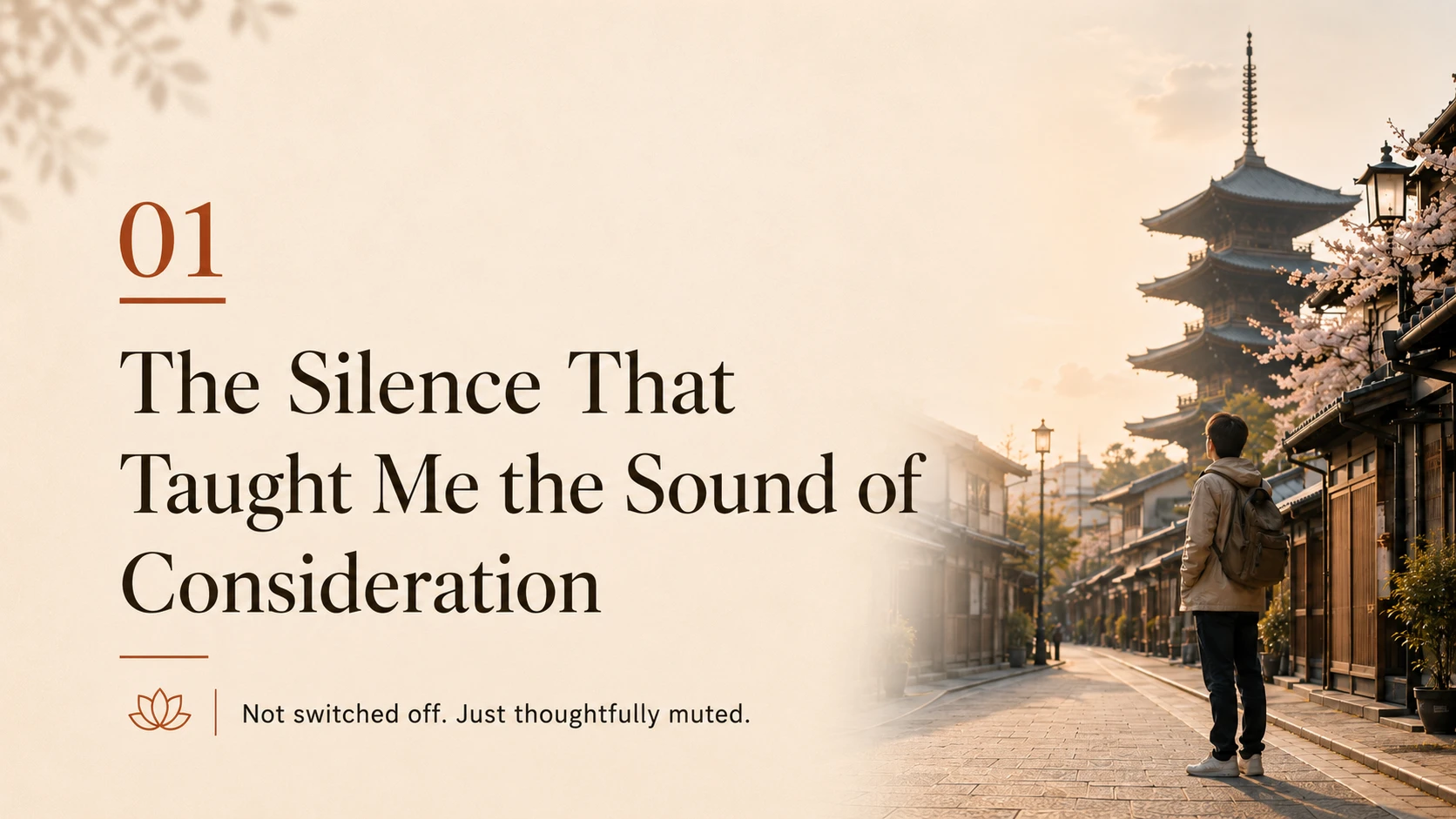
Japan is silent.

Not the uncomfortable kind of silence. Not the silence of an exam hall, where everyone is tense and one cough feels like a national incident. This was a different kind of silence. Calm, intentional, and deeply considerate. It was not the absence of life. It was the absence of unnecessary noise.

During our entire ten days in Japan, we barely heard a horn. No shouting across streets. No loud phone calls in public places. No reels playing on speaker inside trains, buses, shops, or hotel lobbies. Even in crowded spaces, there was a certain softness to the way people moved and spoke. It felt as if the whole country had quietly agreed to press the “mute unnecessary noise” button.

What surprised me most was that the silence did not make people distant. I had imagined that so much quietness might make everyday interactions feel cold or mechanical. But it was quite the opposite. People looked at you when they spoke. They listened fully. They answered clearly. They were courteous without being dramatic about it. The silence around them seemed to create more room for attention.

Every time we got down from the bus, the driver would say something warm to each person. Not as a routine announcement thrown into the air, but almost individually, one by one. There was a sense that every passenger mattered. In shops too, the person helping us was fully present. They were not half-listening while handling three other customers, answering a phone call, and mentally solving an existential crisis. The conversation was quiet, clear, and respectful.

That is what stayed with me.

Japan’s silence was not emptiness. It was attention.

It made me realise that silence can also be a form of hospitality. It allows people to occupy a shared space without being forced into each other’s worlds. A train ride can remain a train ride. A walk can remain a walk. A shop interaction can remain between the person asking and the person helping. There is a gentleness in that.

And as someone who is already famous in my family for being “too silent,” I felt deeply validated. Finally, I had arrived in a country where my personality was not a problem. It was almost national DNA.

The silence I noticed in Japan was not about switching life off. It was about lowering the volume enough for consideration to become audible.

Not switched off. Just thoughtfully muted.

I have seen these yellow lines in other countries too.

But from what I understand, this idea started in Japan.

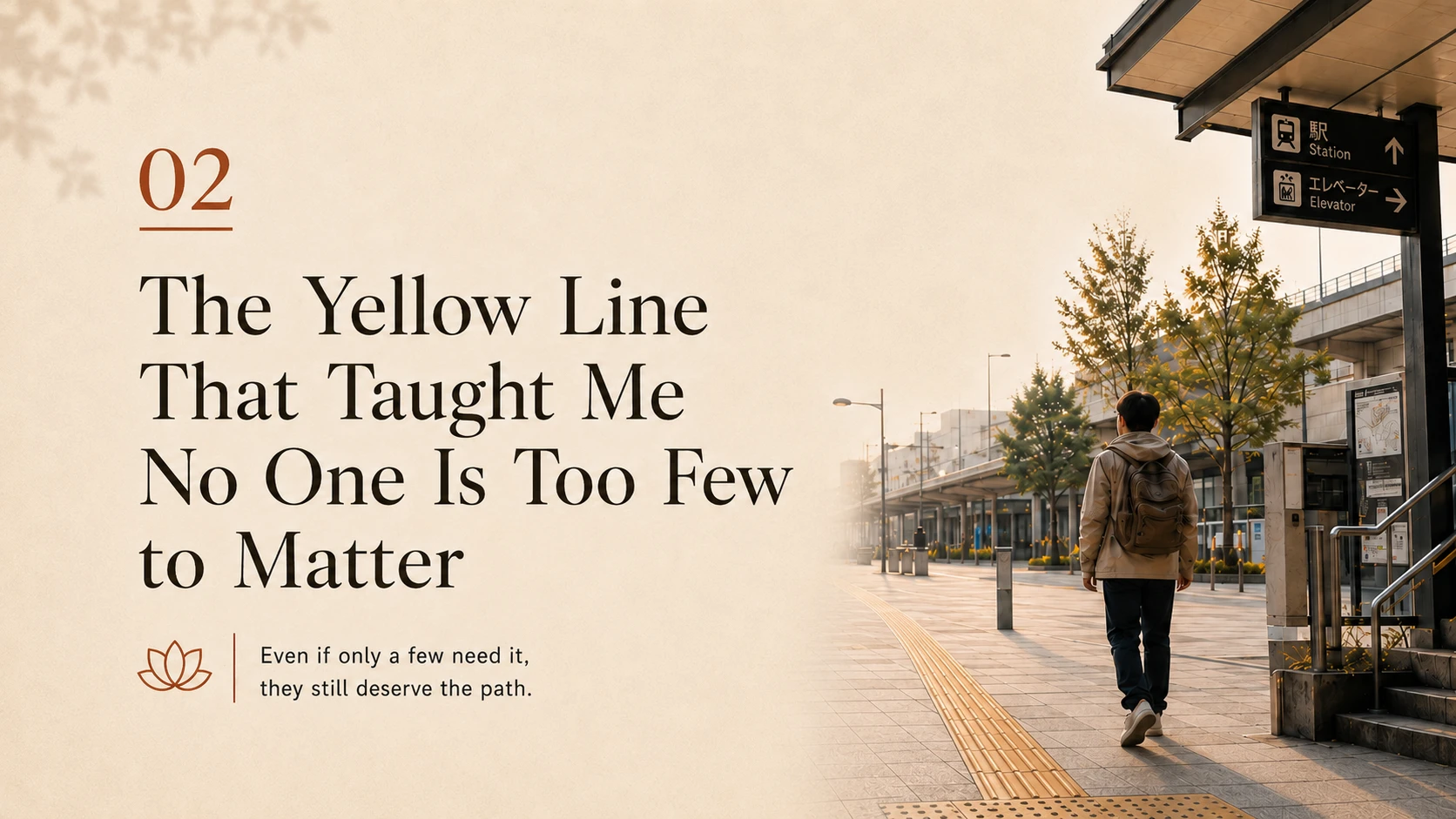
They are called Tenji blocks or tactile paving – raised yellow tiles created to help blind and visually impaired people move through public spaces more safely.

Once our guide explained it, I could not stop noticing them. They were everywhere. On railway platforms. Inside stations.  On footpaths.  Near crossings.  Near lifts and staircases. They are not just random yellow tiles. The parallel raised lines are directional. They guide the person forward – almost like the city saying, “Walk this way.” The raised dots are warning points. They usually mean pause, be alert, or pay attention.

When the guide was explaining this, I was wondering what percentage of Japan’s population is blind or visually impaired. Turned to Google mama – the number is really small about 1.5%.

That is what stayed with me. Such a small percentage of the population. And yet these yellow lines are everywhere. If this was just a token gesture, they could have put them in a few busy streets, a few railway stations, a few places where people could say, “See, we are inclusive.” But this did not feel like a gimmick. It felt like a system.

A country quietly saying: Even if only a few people need this,  they still deserve the path. That is a beautiful thought.

Japan’s yellow line whispered something important.

It said the person who may not be visible to us still matters. The yellow line taught me that care is not a numbers game. 

No one is too few to matter.

I was told Japan is a clean country. That was an understatement. Japan is not clean. Japan is clean-clean. No dust, no litter, no mysterious plastic cover flying dramatically in the wind, no tea cup under a bench, no snack packet having an independent life on the pavement. Everything is spotless.
 
So naturally, my Indian brain started looking for the secret. Maybe there are dustbins everywhere? Every corner, every station, every street, every shop entrance. One dustbin for plastic, one for paper, one for emotions. But no. That is where Japan attacks your logic. There are hardly any dustbins.
 
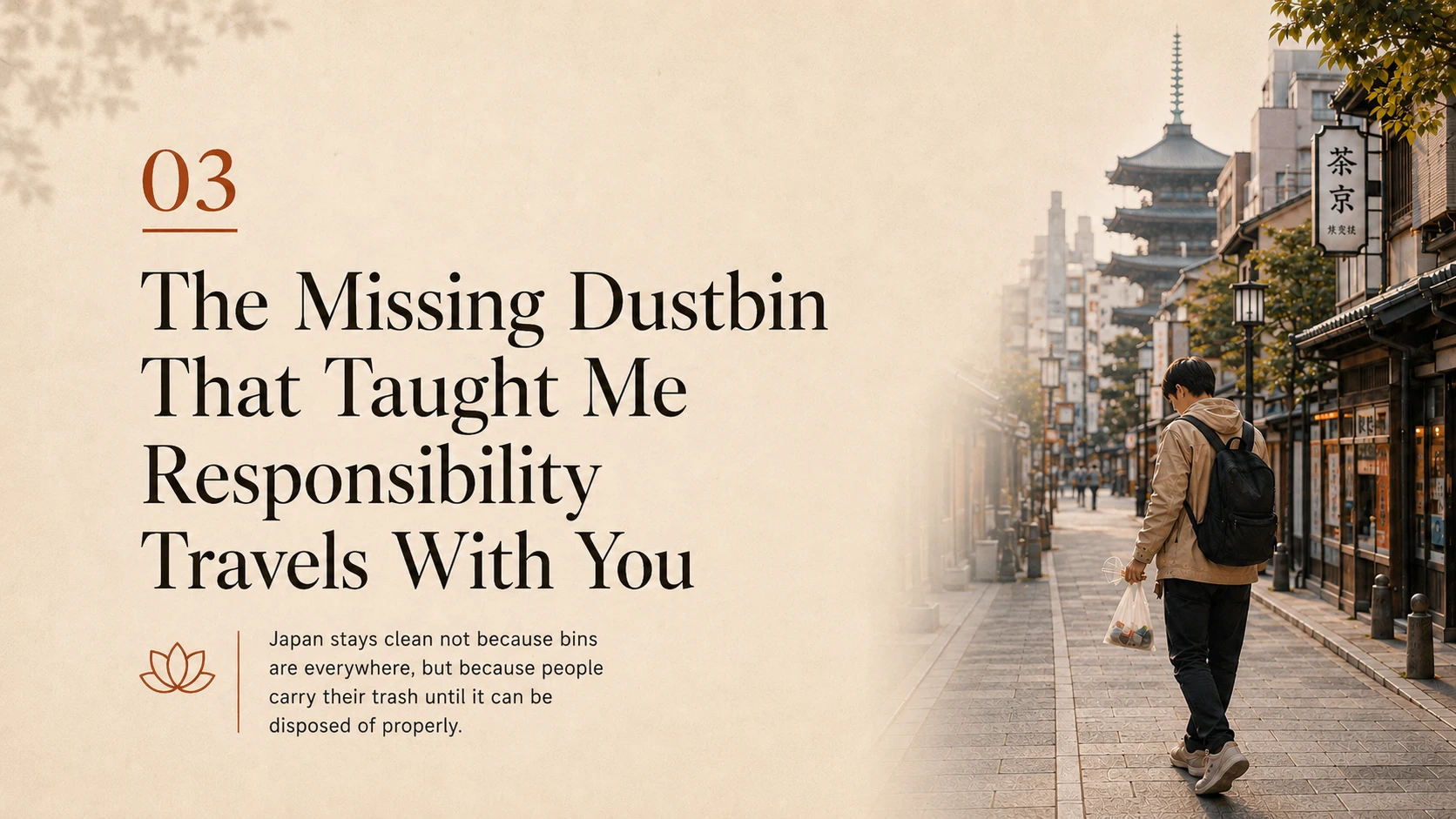
I was confused. How can a country be this clean when the dustbin has gone into witness protection? In Japan, if you create trash, it remains yours. You carry it until you find the right place to dispose of it.
 
Basically, Japan has made every citizen a walking dustbin. Elegant. Internal. Highly disciplined. And slightly terrifying for people like us who are used to looking around hopefully after finishing anything.
 
I learnt this the hard way. One day, I bought ice cream and, in a moment of complete foolishness, asked for a cup instead of a cone. Big mistake. A cone would have quietly disappeared into our system. The cup, however, became my adopted child. I carried it carefully, protected it, worried about it, made space for it in my bag. At one point, I think we developed a relationship.
 
And that is when the real lesson landed. The streets are clean not because someone is constantly cleaning up after everyone. They are clean because people have accepted one simple idea: “My trash is still my responsibility.”
 
Japan quietly seems to say, “Please carry your own problem for a little longer.”
 
What fascinated me even more is that this works in Tokyo and Osaka too – cities full of tourists. Which means visitors also adjust. Even we adjust. Your brain changes settings. Suddenly, you think before buying something, you think before opening a packet, you think before choosing cup over cone. You become strangely attached to your own garbage.

In my family, I am known as the timing tyrant. I get deeply disturbed if I am late for anything, and even more disturbed if others do not respect time. I have turned down meetings when someone came late. Once, a car dealer drove all the way home with a test vehicle, reached five minutes late, and I politely asked him to come some other time. Some may call this extreme. If there is one thing I find difficult to respect, it is a casual attitude towards time. For me, time is not just a number on a clock. It is a promise. When we say 9:00, we are not merely announcing a time. We are telling another person, “Your time matters to me.”

When I think back to where this came from, it is undeniably from my school, DAV Higher Secondary School, and our principal, Mr. Ram Kalia. From class three, I used to travel from Nanganallur to Gopalapuram, which involved one train and two buses. The mission was simple: reach before the first bell. If you did not, you were either sent back home or made to stand in the latecomers’ line.

And then Mr. Ram Kalia would arrive. Let us just say he did not conduct motivational workshops on punctuality. He believed in military-style clarity. In today’s world, where teachers are sometimes scared to even raise an eyebrow at children, I look back with strange gratitude. We had teachers who drilled certain values into us so deeply that they stayed for life. Punctuality was not optional. It was character training disguised as school timing.

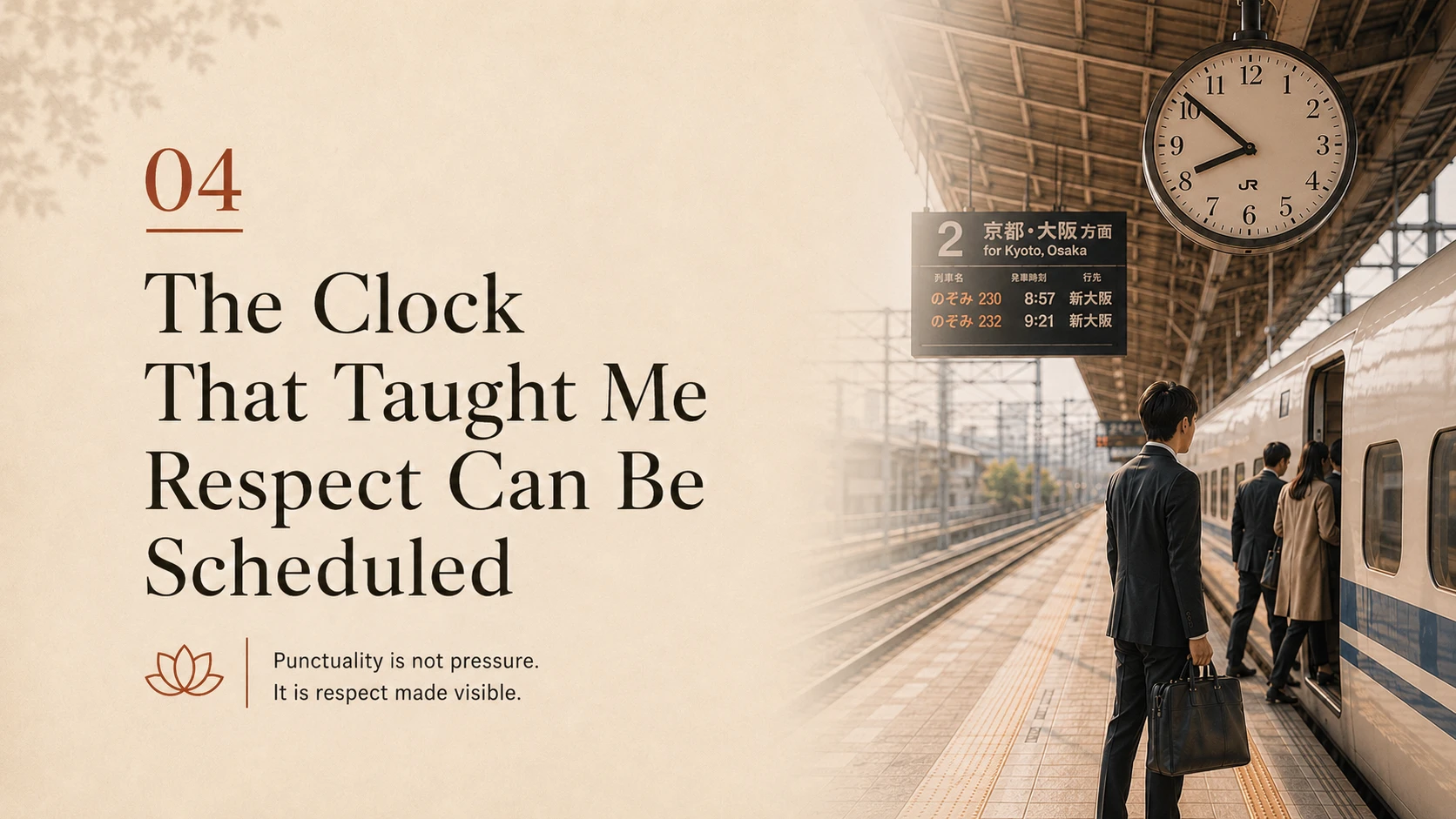
So when I reached Japan, a country where time seems to be treated with almost sacred seriousness, my eyes lit up. Finally, I had found a whole nation that made my timing obsession look mild. In Japan, things do not merely happen on time. They happen with seconds-level precision. Trains arrive when they say they will. Buses leave when they are meant to. Tours begin as scheduled. Even the smallest delay feels like an event that needs explanation.

I was told that when trains are late, railway staff may even issue delay certificates so people can show their employers that the delay was caused by the train and not by them. Imagine that level of accountability. In some places, being late becomes a personal negotiation. In Japan, even the system takes responsibility for wasting your time.

That is what stayed with me. Japan’s timing is not just efficiency. It is respect made visible. It says, “I will not casually take away minutes from your life.” It says, “If you planned around this time, I will honour that plan.” It says, “Your day matters.”

The clock in Japan whispered something simple to me: punctuality is not about being strict. It is about being considerate.


And somewhere, I think Mr. Ram Kalia would have approved.

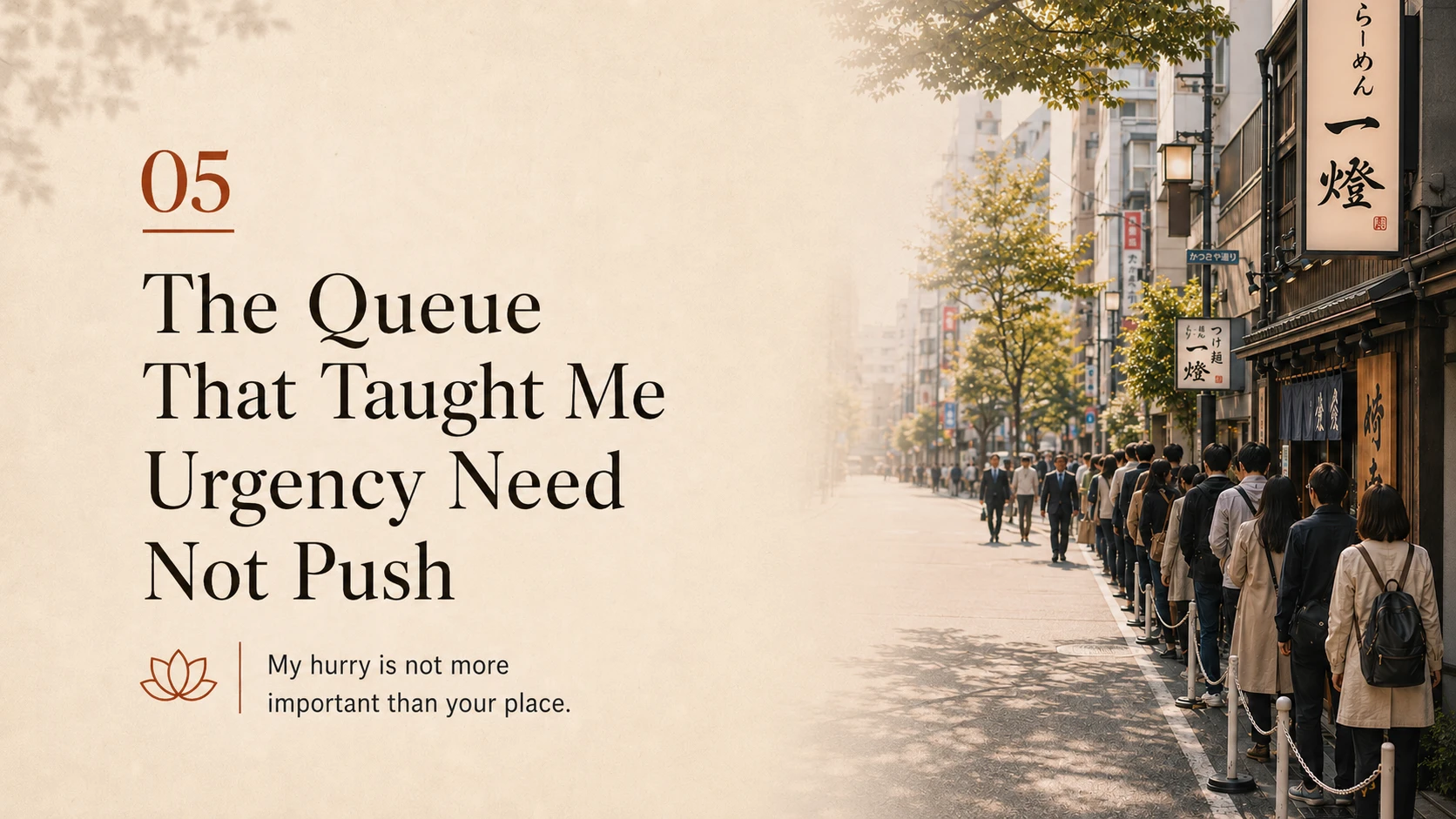
In Japan, queues are everywhere. At train stations, restaurants, shops, elevators, bus stops, vending machines, everywhere. And what is most shocking is not that people stand in queues. It is that they stay in queues. No side entry. No silent drifting. No “I was standing here only.” No uncle suddenly appearing from the left with the confidence of diplomatic immunity.
 
People wait. Calmly. Quietly. Without drama.
 
Outside some restaurants, the queue was not even directly in front of the restaurant. Since the sidewalk was busy, people formed the line on the road side of the pavement, leaving walking space free for others. They were waiting for their own meal, but still thinking about strangers who had nothing to do with their hunger.
 
That stayed with me.
 
Because a queue is not just about order. It is about trust. It says, “I will wait for my turn because I believe you will wait for yours.”
 
The queue whispered something simple: My hurry is not more important than your place.
 
And sometimes, civilisation is just patience standing in a straight line.
In most of the shrines we visited, we saw vending machines that could imprint your name on a coin. We found one and wanted to get it done. After all, when a machine offers to put your name on something, the tourist brain immediately says, “This is clearly essential.”

We checked the price. It said 30 yen. So naturally, we put in 30 yen and waited for our personalised coin to emerge. Nothing happened. We pressed a few buttons with great confidence, which is usually the first stage of not knowing what you are doing. Still nothing.

So we called the person in charge. That was when we realised the small detail we had missed. First, we had to buy the coin. Only then could we use the machine to imprint it. Minor detail. Only the entire point of the machine. So we bought the coin, came back, and the machine asked for 30 yen again. We told the shopkeeper, “We already put the money in.” He did not ask for proof. He did not inspect the machine. He did not call for CCTV footage. He did not set up a three-member investigation committee to study the mysterious disappearance of 30 yen. He simply nodded, reset the machine, and asked us to go ahead.

It was only 30 yen. But the amount was not the point. The point was trust.

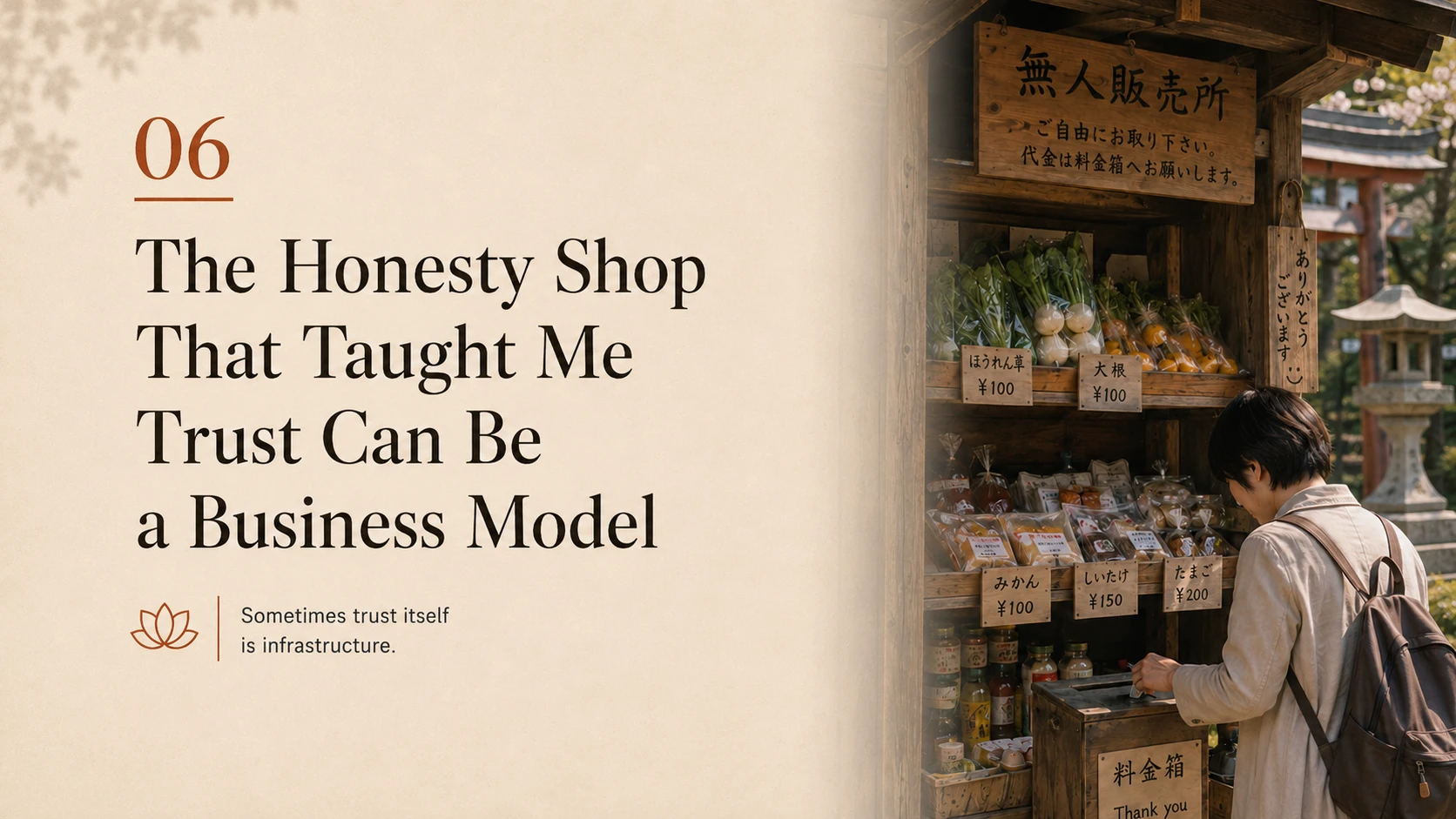
Later, our tour guide told us about Mujin Hanbaisho, unmanned shops or honesty shops, often seen in villages and rural areas. You pick what you want, calculate the amount, drop the money, and leave. A shop whose main security system is your conscience.

That stayed with me. In many places, systems are built assuming people may cheat. So we add locks, counters, tokens, supervisors, and sometimes one extra person whose only job is to watch the watcher. But here was a small reminder that trust can also be infrastructure.

The honesty shop whispered something simple: a society becomes lighter when trust does not need a receipt.

And sometimes, even 30 yen can teach a very expensive lesson.

Comments:

  • Sukumar Rajagopal

    May 18, 2026

    Fantastic travelogue VM or shall I say marvelous.

    reply...
  • N. Ramarathnam

    May 18, 2026

    Awesome commentary about your experience in Japan Maheshji. I enjoyed reading every bit of it and no one can express these facts any better than how you have presented.
    Noise pollution and breaking lines are two behaviors that tested my patience during my recent trip to India. People use mobile phones in trains (Vande Bharat), listening to music and “Thalaiva’s speeches” loudly, without any due consideration to fellow passengers. Likewise getting ahead/breaking lines in temples to get early darshan, even by educated TamBrahms, irritated me a lot.
    Excellent write up and I am glad you and Arunaji thoroughly enjoyed your visit to Nippon.

    reply...
  • Mukundan

    May 18, 2026

    Brilliant. As a co traveller I could easily relate but not express myself. This is wonderful to read and relate.

    reply...

Post a comment