In my family, I am known as the timing tyrant. I get deeply disturbed if I am late for anything, and even more disturbed if others do not respect time. I have turned down meetings when someone came late. Once, a car dealer drove all the way home with a test vehicle, reached five minutes late, and I politely asked him to come some other time. Some may call this extreme. If there is one thing I find difficult to respect, it is a casual attitude towards time. For me, time is not just a number on a clock. It is a promise. When we say 9:00, we are not merely announcing a time. We are telling another person, “Your time matters to me.”
When I think back to where this came from, it is undeniably from my school, DAV Higher Secondary School, and our principal, Mr. Ram Kalia. From class three, I used to travel from Nanganallur to Gopalapuram, which involved one train and two buses. The mission was simple: reach before the first bell. If you did not, you were either sent back home or made to stand in the latecomers’ line.
And then Mr. Ram Kalia would arrive. Let us just say he did not conduct motivational workshops on punctuality. He believed in military-style clarity. In today’s world, where teachers are sometimes scared to even raise an eyebrow at children, I look back with strange gratitude. We had teachers who drilled certain values into us so deeply that they stayed for life. Punctuality was not optional. It was character training disguised as school timing.
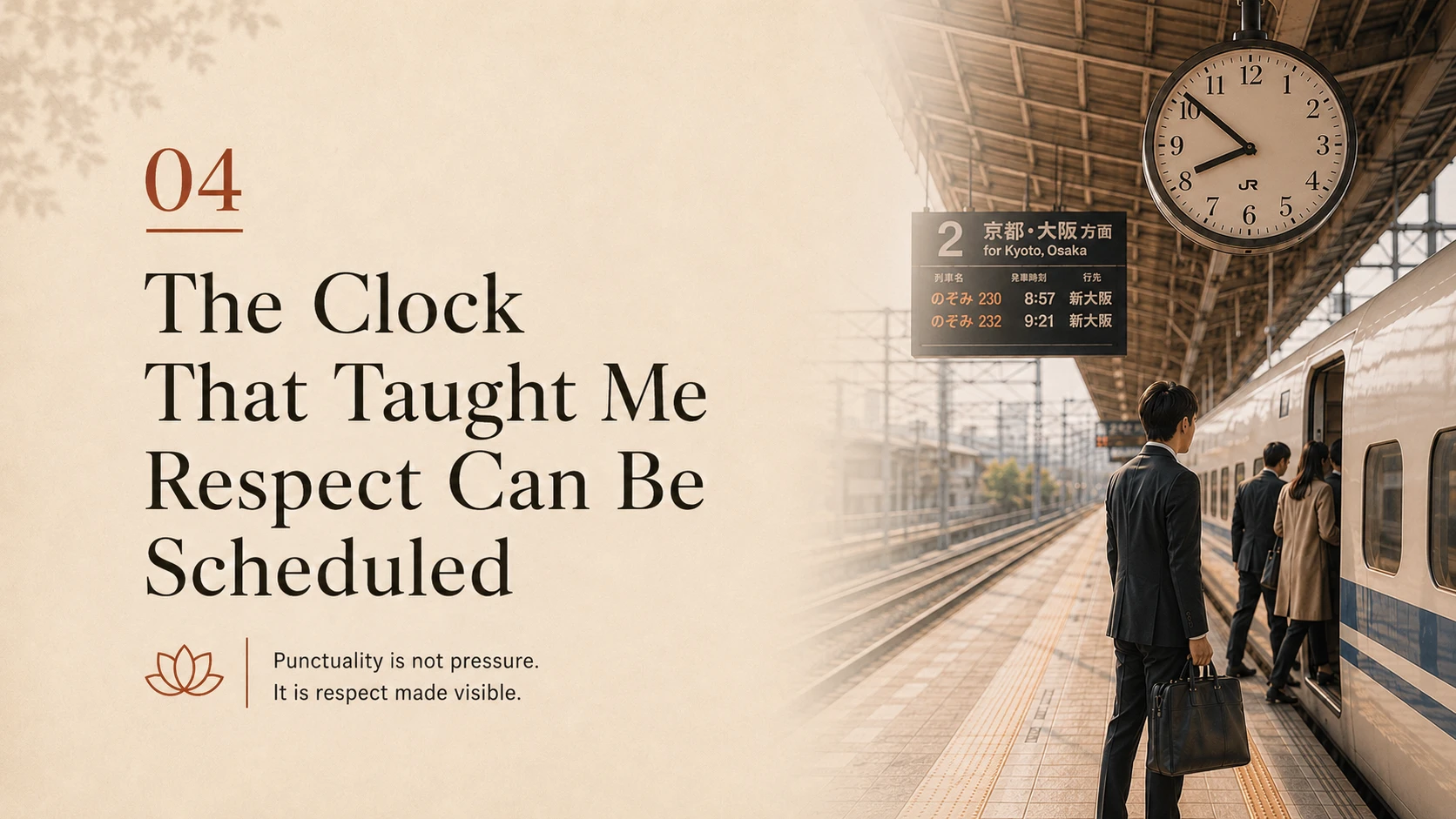
So when I reached Japan, a country where time seems to be treated with almost sacred seriousness, my eyes lit up. Finally, I had found a whole nation that made my timing obsession look mild. In Japan, things do not merely happen on time. They happen with seconds-level precision. Trains arrive when they say they will. Buses leave when they are meant to. Tours begin as scheduled. Even the smallest delay feels like an event that needs explanation.
I was told that when trains are late, railway staff may even issue delay certificates so people can show their employers that the delay was caused by the train and not by them. Imagine that level of accountability. In some places, being late becomes a personal negotiation. In Japan, even the system takes responsibility for wasting your time.
That is what stayed with me. Japan’s timing is not just efficiency. It is respect made visible. It says, “I will not casually take away minutes from your life.” It says, “If you planned around this time, I will honour that plan.” It says, “Your day matters.”
The clock in Japan whispered something simple to me: punctuality is not about being strict. It is about being considerate.
And somewhere, I think Mr. Ram Kalia would have approved.







Sukumar Rajagopal
Fantastic travelogue VM or shall I say marvelous.
Mahesh Venkateswaran
Ha ha thank Sukumar. Good one.
N. Ramarathnam
Awesome commentary about your experience in Japan Maheshji. I enjoyed reading every bit of it and no one can express these facts any better than how you have presented.
Noise pollution and breaking lines are two behaviors that tested my patience during my recent trip to India. People use mobile phones in trains (Vande Bharat), listening to music and “Thalaiva’s speeches” loudly, without any due consideration to fellow passengers. Likewise getting ahead/breaking lines in temples to get early darshan, even by educated TamBrahms, irritated me a lot.
Excellent write up and I am glad you and Arunaji thoroughly enjoyed your visit to Nippon.
Mahesh Venkateswaran
Thanks so much for your kind words.
Mukundan
Brilliant. As a co traveller I could easily relate but not express myself. This is wonderful to read and relate.
Mahesh Venkateswaran
Thank you Mukundan sir
Sarvesh
Sweet, Mahesh!
Mahesh Venkateswaran
Thanks Sarvesh
Sachin
Just Awesome!
Kita
Beautifully written VM! Japan is now on my must visit list! I too am a time tyrant and get unreasonably angry when people dont respect time (mine or others)! I hate being late to anything too! So I get your perspective.
The point about trash is unbelievable! That tourists automatically fall in line is surprising! One wonders if they carry that spirit back home to wherever they came from!
Mahesh Venkateswaran
Thank you Kita.
Sudha Natarajan
Dear Mahesh,
Thank you for writing this and sharing with us. I enjoyed your observations. I felt I was reading a meditation journal. Everything seemed like being mindful of our own actions. Now I am more determined to visit Japan.
Thank you
Best Regards
Sudha
Mahesh Venkateswaran
Thank you for your kind words. Yes there are some countries we know little about and it hits on you why it took so long to experience it. Japan is one of those countries. The same way we felt about Iceland.
Bala
Hi Mahesh,
I greatly enjoyed the write-up and the imagery it invoked….almost as if I had made the trip myself. Keep these travel vlogs coming so I/we can vicariously enjoy the experiences.
Balaji
P.S. I kept scrolling down for the food review 🙂 without luck…perhaps you’ll add a sequel
Mahesh Venkateswaran
Thanks so much. Food unfortunately we didnt explore much this time. But Vegan food are available in plenty and we were happy about it.
Balachandhran Venugopalan
This is beautifully written Mahesh. Aside of the astute articulation the content makes one want to go there. This one country seems special in many ways. The trust shop reminds me of Karma Kitchen (check it out on youtube — as also Nipun Mehta).. Thank you for taking the time.
Mahesh Venkateswaran
Thank you Bala. Will check them out.